Filters
Question type

Study Flashcards

What is the value for the van't Hoff factor for all nonelectrolytes?


A) -1
B) 0
C) 1
D) ½
E) -½

F) A) and C)
G) None of the above

Correct Answer

verifed

verified

Hydration is the process in which organic solvent molecules surround a solute particle.

A) True
B) False

Correct Answer

verifed

verified

What is the freezing point of a solution prepared from 50.0 g ethylene glycol (C2H6O2) and 85.0 g H2O? (For water, Kf = 1.86°C/m)


A) 17.6°C
B) -176°C
C) -1.50°C
D) 1.50°C
E) -17.6°C

F) A) and E)
G) C) and D)

Correct Answer

verifed

verified

Carbon tetrachloride, once widely used in fire extinguishers and as a dry cleaning fluid, has been found to cause liver damage to those exposed to its vapors over long periods of time. What is the boiling point of a solution prepared by dissolving 375 g of sulfur (S8, 256.5 g/mol) in 1250 g of CCl4? (For CCl4, Kb = 5.05°C/m; boiling point of pure CCl4 = 76.7°C)


A) 70.8°C
B) 75.2°C
C) 78.2°C
D) 82.6°C
E) 85.7°C

F) C) and D)
G) A) and D)

Correct Answer

verifed

verified

What mass of water is required to dissolve 25.31 g of potassium nitrate (KNO3) in order to prepare a 0.1982 m solution?


A) 0.5101 kg
B) 0.1277 kg
C) 1.000. kg
D) 1.263 kg
E) 0.7917 kg

F) B) and C)
G) A) and C)

Correct Answer

verifed

verified

The solubility of nitrogen gas in water at 25°C and a nitrogen pressure of 522 mmHg is 4.7 × 10⁻⁴ mol/L. What is the value of the Henry's law constant in mol L-1• atm-1?


A) 6.8 × 10⁻⁴ mol L-1• atm-1
B) 4.7 × 10⁻⁴ mol L-1• atm-1
C) 3.2 × 10⁻⁴ mol L-1• atm-1
D) 9.0 × 10⁻⁷ mol L-1• atm-1
E) 1.5 × 10³ mol L-1• atm-1

F) C) and D)
G) D) and E)

Correct Answer

verifed

verified

What is the molarity of a solution prepared by diluting 1.85 L of 6.5 M KOH to 11.0 L?


A) 0.28 M
B) 0.91 M
C) 1.1 M
D) 3.1 M
E) 3.9 M

F) A) and C)
G) A) and D)

Correct Answer

verifed

verified

A solution of potassium hydroxide is in equilibrium with undissolved solute at 45°C. What will happen if the temperature is raised to 50°C? (ΔHsoln = -57.6 kJ/mol)


A) The mass of undissolved KOH will increase.
B) The mass of undissolved KOH will decrease.
C) The mass of undissolved KOH will be unchanged.
D) The mass of water in the solution will increase.
E) The entropy of the system will decrease.

F) C) and E)
G) A) and C)

Correct Answer

verifed

verified

Which of these compounds is a nonelectrolyte?


A) NaF
B) HNO3
C) CH3COOH (acetic acid)
D) NaOH
E) C6H12O6 (glucose)

F) B) and D)
G) None of the above

Correct Answer

verifed

verified

Which is true regarding the solvation of a solute in a solvent?


A) Separation of solute molecules from one another is an endothermic process, and separation of solvent molecules from one another is an exothermic process.
B) Separation of solute molecules from one another is an exothermic process, and separation of solvent molecules from one another is an endothermic process.
C) Separation of solute molecules from one another, and separation of solvent molecules from one another, are both endothermic processes.
D) Separation of solute molecules from one another, and separation of solvent molecules from one another, are both exothermic processes.
E) Separation of solute molecules from one another, and separation of solvent molecules from one another, both result in a decrease in entropy.

F) B) and D)
G) C) and D)

Correct Answer

verifed

verified

When a nonvolatile solute is dissolved in a liquid, the vapor pressure exerted by the liquid decreases.

A) True
B) False

Correct Answer

verifed

verified

Diethyl ether has a vapor pressure of 400.0 torr at 18°C. When a sample of benzoic acid is dissolved in ether, the vapor pressure of the solution is 342 torr. What is the mole fraction of benzoic acid in the solution?


A) 0.0169
B) 0.0197
C) 0.145
D) 0.855
E) 0.045

F) A) and B)
G) B) and D)

Correct Answer

verifed

verified

Explain the following, on the basis of osmosis or osmotic pressure: In trees and plants, water is drawn from the soil up into the branches and leaves.

Correct Answer

verifed

verified

The water passes into the cell...

View Answer

Which of the following aqueous solutions should demonstrate the most nonideal behavior?


A) 0.1 M NaI
B) 0.2 M CuSO4
C) 0.5 M KBr
D) 2.0 M CuCl2
E) 2.5 M CsCl

F) B) and D)
G) A) and E)

Correct Answer

verifed

verified

Which substance is present in the largest proportion in a solution?


A) salute
B) gas
C) solvent
D) solid
E) solute

F) A) and B)
G) None of the above

Correct Answer

verifed

verified

A solution is 40.00% by volume benzene (C6H6) in carbon tetrachloride at 20°C. The vapor pressure of pure benzene at this temperature is 74.61 mmHg and its density is 0.87865 g/cm3; the vapor pressure of pure carbon tetrachloride is 91.32 mmHg and its density is 1.5940 g/cm3. If this solution is ideal, its total vapor pressure at 20°C is


A) 84.64 mmHg.
B) 84.30 mmHg.
C) 82.96 mmHg.
D) 81.63 mmHg.
E) 165.93 mmHg.

F) A) and B)
G) A) and C)

Correct Answer

verifed

verified

The solubility of oxygen in lakes high in the Rocky Mountains is affected by the altitude. If the aqueous solubility of atmospheric O2 is 2.67 × 10⁻⁴ M at sea level and 25°C, what is the solubility of O2 at an elevation of 12,000 ft where the total pressure is 0.657 atm? Assume the temperature is 25°C, and that the mole fraction of O2 in air is 0.209 at both 12,000 ft and at sea level.


A) 1.75 × 10⁻⁴ M
B) 2.67 × 10⁻⁴ M
C) 3.66 × 10⁻⁵ M
D) 4.06 × 10⁻⁴ M
E) 5.58 × 10⁻⁵ M

F) None of the above
G) All of the above

Correct Answer

verifed

verified

Explain the following, on the basis of osmosis or osmotic pressure: Drinking salt water actually dehydrates our tissues.

Correct Answer

verifed

verified

The water passes fro...

View Answer

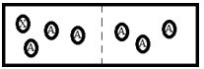
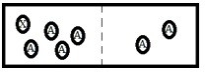
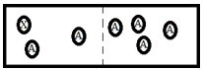
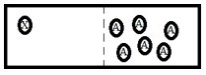
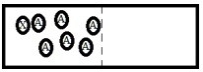
Below is a diagram representing two chambers containing solvent A, separated by a semipermeable membrane (a dashed line) which allows only solvent A to pass through. Below is a diagram representing two chambers containing solvent A, separated by a semipermeable membrane (a dashed line)  which allows only solvent A to pass through.   If a solute X is added to the chamber on the left, which diagram below best represents how the system will respond in order to reach a new equilibrium? A)    B)    C)    D)    E)   If a solute X is added to the chamber on the left, which diagram below best represents how the system will respond in order to reach a new equilibrium?


A) Below is a diagram representing two chambers containing solvent A, separated by a semipermeable membrane (a dashed line)  which allows only solvent A to pass through.   If a solute X is added to the chamber on the left, which diagram below best represents how the system will respond in order to reach a new equilibrium? A)    B)    C)    D)    E)
B) Below is a diagram representing two chambers containing solvent A, separated by a semipermeable membrane (a dashed line)  which allows only solvent A to pass through.   If a solute X is added to the chamber on the left, which diagram below best represents how the system will respond in order to reach a new equilibrium? A)    B)    C)    D)    E)
C) Below is a diagram representing two chambers containing solvent A, separated by a semipermeable membrane (a dashed line)  which allows only solvent A to pass through.   If a solute X is added to the chamber on the left, which diagram below best represents how the system will respond in order to reach a new equilibrium? A)    B)    C)    D)    E)
D) Below is a diagram representing two chambers containing solvent A, separated by a semipermeable membrane (a dashed line)  which allows only solvent A to pass through.   If a solute X is added to the chamber on the left, which diagram below best represents how the system will respond in order to reach a new equilibrium? A)    B)    C)    D)    E)
E) Below is a diagram representing two chambers containing solvent A, separated by a semipermeable membrane (a dashed line)  which allows only solvent A to pass through.   If a solute X is added to the chamber on the left, which diagram below best represents how the system will respond in order to reach a new equilibrium? A)    B)    C)    D)    E)

F) A) and C)
G) A) and D)

Correct Answer

verifed

verified

What is the freezing point of a solution made from 22.0 g of octane (C8H18) dissolved in 148.0 g of benzene? (For benzene, freezing point = 5.50°C; Kf = 5.12°C/m)


A) -1.16°C
B) 0.98°C
C) 6.66°C
D) 12.2°C
E) 5.49°C

F) B) and C)
G) B) and D)

Correct Answer

verifed

verified

Showing 121 - 140 of 151

Related Exams

Show Answer